From Publishers Weekly
Starred Review. Kinney's popular Web comic, which began in 2004, makes its way to print as a laugh-out-loud "novel in cartoons," adapted from the series. Middle school student Greg Heffley takes readers through an academic year's worth of drama. Greg's mother forces him to keep a diary ("I know what it says on the cover, but when Mom went out to buy this thing I specifically told her to get one that didn't say 'diary' on it"), and in it he loosely recounts each day's events, interspersed with his comic illustrations. Kinney has a gift for believable preteen dialogue and narration (e.g., "Don't expect me to be all 'Dear Diary' this and 'Dear Diary' that"), and the illustrations serve as a hilarious counterpoint to Greg's often deadpan voice. The hero's utter obliviousness to his friends and family becomes a running joke. For instance, on Halloween, Greg and his best friend, Rowley, take refuge from some high school boys at Greg's grandmother's house; they taunt the bullies, who then T.P. her house. Greg's journal entry reads, "I do feel a little bad, because it looked like it was gonna take a long time to clean up. But on the bright side, Gramma is retired, so she probably didn't have anything planned for today anyway." Kinney ably skewers familiar aspects of junior high life, from dealing with the mysteries of what makes someone popular to the trauma of a "wrestling unit" in gym class. His print debut should keep readers in stitches, eagerly anticipating Greg's further adventures. Ages 8-13. (Apr.)
Copyright © Reed Business Information, a division of Reed Elsevier Inc. All rights reserved.
From School Library Journal
Grade 5–8—Greg Heffley has actually been on the scene for more than two years. Created by an online game developer, he has starred in a Web book of the same name on www.funbrain.com since May 2004. This print version is just as engaging. Kinney does a masterful job of making the mundane life of boys on the brink of adolescence hilarious. Greg is a conflicted soul: he wants to do the right thing, but the constant quest for status and girls seems to undermine his every effort. His attempts to prove his worthiness in the popularity race (he estimates he's currently ranked 52nd or 53rd) are constantly foiled by well-meaning parents, a younger and older brother, and nerdy friends. While Greg is not the most principled protagonist, it is his very obliviousness to his faults that makes him such an appealing hero. Kinney's background as a cartoonist is apparent in this hybrid book that falls somewhere between traditional prose and graphic novel. It offers some of the same adventures as the Web book, but there are enough new subplots to entertain Funbrain followers. This version is more pared down, and the pace moves quickly. The first of three installments, it is an excellent choice for reluctant readers, but more experienced readers will also find much to enjoy and relate to in one seventh grader's view of the everyday trials and tribulations of middle school.—Kim Dare, Fairfax County Public Schools, VA
Copyright © Reed Business Information, a division of Reed Elsevier Inc. All rights reserved.
see more product details and buy at amazon.com
Minggu, 13 Juli 2008 10.08
Diary of a Wimpy Kid (Hardcover), by Jeff Kinney

10.05
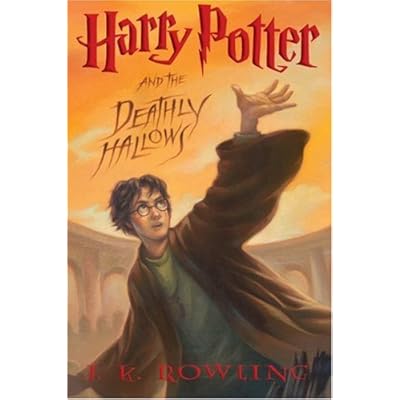
Harry Potter and the Deathly Hallows (Book 7) (Hardcover), low price
Readers beware. The brilliant, breathtaking conclusion to J.K. Rowling's spellbinding series is not for the faint of heart--such revelations, battles, and betrayals await in Harry Potter and the Deathly Hallows that no fan will make it to the end unscathed. Luckily, Rowling has prepped loyal readers for the end of her series by doling out increasingly dark and dangerous tales of magic and mystery, shot through with lessons about honor and contempt, love and loss, and right and wrong. Fear not, you will find no spoilers in our review--to tell the plot would ruin the journey, and Harry Potter and the Deathly Hallows is an odyssey the likes of which Rowling's fans have not yet seen, and are not likely to forget. But we would be remiss if we did not offer one small suggestion before you embark on your final adventure with Harry--bring plenty of tissues.
The heart of Book 7 is a hero's mission--not just in Harry's quest for the Horcruxes, but in his journey from boy to man--and Harry faces more danger than that found in all six books combined, from the direct threat of the Death Eaters and you-know-who, to the subtle perils of losing faith in himself. Attentive readers would do well to remember Dumbledore's warning about making the choice between "what is right and what is easy," and know that Rowling applies the same difficult principle to the conclusion of her series. While fans will find the answers to hotly speculated questions about Dumbledore, Snape, and you-know-who, it is a testament to Rowling's skill as a storyteller that even the most astute and careful reader will be taken by surprise.
A spectacular finish to a phenomenal series, Harry Potter and the Deathly Hallows is a bittersweet read for fans. The journey is hard, filled with events both tragic and triumphant, the battlefield littered with the bodies of the dearest and despised, but the final chapter is as brilliant and blinding as a phoenix's flame, and fans and skeptics alike will emerge from the confines of the story with full but heavy hearts, giddy and grateful for the experience. --Daphne Durham
From Publishers Weekly
Starred Review. Potter fans, relax—this review packs no spoilers. Instead, we're taking advantage of our public platform to praise Rowling for the excellence of her plotting. We can't think of anyone else who has sustained such an intricate, endlessly inventive plot over seven thick volumes and so constantly surprised us with twists, well-laid traps and Purloined Letter-style tricks. Hallows continues the tradition, both with sly feats of legerdemain and with several altogether new, unexpected elements. Perhaps some of the surprises in Hallows don't have quite the punch as those of earlier books, but that may be because of the thoroughness and consistency with which Rowling has created her magical universe, and because we've so raptly absorbed its rules.
We're also seizing the occasion to wish out loud that her editors had done their jobs more actively. It's hard to escape the notion that the first three volumes were more carefully edited than the last four. Hallows doesn't contain the extraneous scenes found in, say, Goblet of Fire, but the momentum is uneven. Rowling is much better at comedy than at fight scenes, and no reader of the sixth book will be startled to hear that Hallows has little humor or that its characters engage in more than a few fights. Surely her editors could have helped her find other methods of building suspense besides the use of ellipses and dashes? And craft fight dialogue that sounds a bit less like it belongs in a comic book? Okay, we're quibbling. We know these minor nuisances won't dent readers' enjoyment, at least not this generation of readers; we couldn't put Hallows down ourselves. But we believe Rowling, and future readers, deserved even better. Ages 9-12. (July)
Copyright © Reed Business Information, a division of Reed Elsevier Inc. All rights reserved.
see more product details and buy at amazon.com
10.02
The Glass Castle: A Memoir (Paperback), by Jeannette Walls
Jeannette Walls's father always called her "Mountain Goat" and there's perhaps no more apt nickname for a girl who navigated a sheer and towering cliff of childhood both daily and stoically. In The Glass Castle, Walls chronicles her upbringing at the hands of eccentric, nomadic parents--Rose Mary, her frustrated-artist mother, and Rex, her brilliant, alcoholic father. To call the elder Walls's childrearing style laissez faire would be putting it mildly. As Rose Mary and Rex, motivated by whims and paranoia, uprooted their kids time and again, the youngsters (Walls, her brother and two sisters) were left largely to their own devices. But while Rex and Rose Mary firmly believed children learned best from their own mistakes, they themselves never seemed to do so, repeating the same disastrous patterns that eventually landed them on the streets. Walls describes in fascinating detail what it was to be a child in this family, from the embarrassing (wearing shoes held together with safety pins; using markers to color her skin in an effort to camouflage holes in her pants) to the horrific (being told, after a creepy uncle pleasured himself in close proximity, that sexual assault is a crime of perception; and being pimped by her father at a bar). Though Walls has well earned the right to complain, at no point does she play the victim. In fact, Walls' removed, nonjudgmental stance is initially startling, since many of the circumstances she describes could be categorized as abusive (and unquestioningly neglectful). But on the contrary, Walls respects her parents' knack for making hardships feel like adventures, and her love for them--despite their overwhelming self-absorption--resonates from cover to cover. --Brangien Davis --This text refers to the Hardcover edition.
From Publishers Weekly
Starred Review. Freelance writer Walls doesn't pull her punches. She opens her memoir by describing looking out the window of her taxi, wondering if she's "overdressed for the evening" and spotting her mother on the sidewalk, "rooting through a Dumpster." Walls's parents—just two of the unforgettable characters in this excellent, unusual book—were a matched pair of eccentrics, and raising four children didn't conventionalize either of them. Her father was a self-taught man, a would-be inventor who could stay longer at a poker table than at most jobs and had "a little bit of a drinking situation," as her mother put it. With a fantastic storytelling knack, Walls describes her artist mom's great gift for rationalizing. Apartment walls so thin they heard all their neighbors? What a bonus—they'd "pick up a little Spanish without even studying." Why feed their pets? They'd be helping them "by not allowing them to become dependent." While Walls's father's version of Christmas presents—walking each child into the Arizona desert at night and letting each one claim a star—was delightful, he wasn't so dear when he stole the kids' hard-earned savings to go on a bender. The Walls children learned to support themselves, eating out of trashcans at school or painting their skin so the holes in their pants didn't show. Buck-toothed Jeannette even tried making her own braces when she heard what orthodontia cost. One by one, each child escaped to New York City. Still, it wasn't long before their parents appeared on their doorsteps. "Why not?" Mom said. "Being homeless is an adventure."
Copyright © Reed Business Information, a division of Reed Elsevier Inc. All rights reserved. --This text refers to the Hardcover edition.
see more product details and buy at amazon.com

09.59
The Kite Runner (Paperback), low price, promo
In his debut novel, The Kite Runner, Khaled Hosseini accomplishes what very few contemporary novelists are able to do. He manages to provide an educational and eye-opening account of a country's political turmoil--in this case, Afghanistan--while also developing characters whose heartbreaking struggles and emotional triumphs resonate with readers long after the last page has been turned over. And he does this on his first try.
The Kite Runner follows the story of Amir, the privileged son of a wealthy businessman in Kabul, and Hassan, the son of Amir's father's servant. As children in the relatively stable Afghanistan of the early 1970s, the boys are inseparable. They spend idyllic days running kites and telling stories of mystical places and powerful warriors until an unspeakable event changes the nature of their relationship forever, and eventually cements their bond in ways neither boy could have ever predicted. Even after Amir and his father flee to America, Amir remains haunted by his cowardly actions and disloyalty. In part, it is these demons and the sometimes impossible quest for forgiveness that bring him back to his war-torn native land after it comes under Taliban rule. ("...I wondered if that was how forgiveness budded, not with the fanfare of epiphany, but with pain gathering its things, packing up, and slipping away unannounced in the middle of the night.")
Some of the plot's turns and twists may be somewhat implausible, but Hosseini has created characters that seem so real that one almost forgets that The Kite Runner is a novel and not a memoir. At a time when Afghanistan has been thrust into the forefront of America's collective consciousness ("people sipping lattes at Starbucks were talking about the battle for Kunduz"), Hosseini offers an honest, sometimes tragic, sometimes funny, but always heartfelt view of a fascinating land. Perhaps the only true flaw in this extraordinary novel is that it ends all too soon. --Gisele Toueg --This text refers to the Hardcover edition.
From Publishers Weekly
Hosseini's stunning debut novel starts as an eloquent Afghan version of the American immigrant experience in the late 20th century, but betrayal and redemption come to the forefront when the narrator, a writer, returns to his ravaged homeland to rescue the son of his childhood friend after the boy's parents are shot during the Taliban takeover in the mid '90s. Amir, the son of a well-to-do Kabul merchant, is the first-person narrator, who marries, moves to California and becomes a successful novelist. But he remains haunted by a childhood incident in which he betrayed the trust of his best friend, a Hazara boy named Hassan, who receives a brutal beating from some local bullies. After establishing himself in America, Amir learns that the Taliban have murdered Hassan and his wife, raising questions about the fate of his son, Sohrab. Spurred on by childhood guilt, Amir makes the difficult journey to Kabul, only to learn the boy has been enslaved by a former childhood bully who has become a prominent Taliban official. The price Amir must pay to recover the boy is just one of several brilliant, startling plot twists that make this book memorable both as a political chronicle and a deeply personal tale about how childhood choices affect our adult lives. The character studies alone would make this a noteworthy debut, from the portrait of the sensitive, insecure Amir to the multilayered development of his father, Baba, whose sacrifices and scandalous behavior are fully revealed only when Amir returns to Afghanistan and learns the true nature of his relationship to Hassan. Add an incisive, perceptive examination of recent Afghan history and its ramifications in both America and the Middle East, and the result is a complete work of literature that succeeds in exploring the culture of a previously obscure nation that has become a pivot point in the global politics of the new millennium.
Copyright 2003 Reed Business Information, Inc. --This text refers to the Hardcover edition.
see more product details and buy at amazon.com

Selasa, 04 Maret 2008 08.51
Eat, Pray, Love: One Woman's Search for Everything Across Italy, India and Indonesia (Paperback)
From Publishers Weekly
Starred Review. Gilbert (The Last American Man) grafts the structure of romantic fiction upon the inquiries of reporting in this sprawling yet methodical travelogue of soul-searching and self-discovery. Plagued with despair after a nasty divorce, the author, in her early 30s, divides a year equally among three dissimilar countries, exploring her competing urges for earthly delights and divine transcendence. First, pleasure: savoring Italy's buffet of delights--the world's best pizza, free-flowing wine and dashing conversation partners--Gilbert consumes la dolce vita as spiritual succor. "I came to Italy pinched and thin," she writes, but soon fills out in waist and soul. Then, prayer and ascetic rigor: seeking communion with the divine at a sacred ashram in India, Gilbert emulates the ways of yogis in grueling hours of meditation, struggling to still her churning mind. Finally, a balancing act in Bali, where Gilbert tries for equipoise "betwixt and between" realms, studies with a merry medicine man and plunges into a charged love affair. Sustaining a chatty, conspiratorial tone, Gilbert fully engages readers in the year's cultural and emotional tapestry--conveying rapture with infectious brio, recalling anguish with touching candor--as she details her exotic tableau with history, anecdote and impression.
Copyright Reed Business Information, a division of Reed Elsevier Inc. All rights reserved.
From The New Yorker
At the age of thirty-one, Gilbert moved with her husband to the suburbs of New York and began trying to get pregnant, only to realize that she wanted neither a child nor a husband. Three years later, after a protracted divorce, she embarked on a yearlong trip of recovery, with three main stops: Rome, for pleasure (mostly gustatory, with a special emphasis on gelato); an ashram outside of Mumbai, for spiritual searching; and Bali, for "balancing." These destinations are all on the beaten track, but Gilbert's exuberance and her self-deprecating humor enliven the proceedings: recalling the first time she attempted to speak directly to God, she says, "It was all I could do to stop myself from saying, 'I've always been a big fan of your work.'"
Copyright © 2006 The New Yorker --This text refers to the Hardcover edition.
see more product details and buy at amazon.com

Senin, 03 Maret 2008 09.36
A New Earth: Awakening to Your Life's Purpose (Oprah's Book Club, Selection 61) (Paperback)
The highly anticipated follow-up to the 2,000,000 copy bestselling inspirational book, The Power of Now
With his bestselling spiritual guide The Power of Now, Eckhart Tolle inspired millions of readers to discover the freedom and joy of a life lived "in the now." In A New Earth, Tolle expands on these powerful ideas to show how transcending our ego-based state of consciousness is not only essential to personal happiness, but also the key to ending conflict and suffering throughout the world. Tolle describes how our attachment to the ego creates the dysfunction that leads to anger, jealousy, and unhappiness, and shows readers how to awaken to a new state of consciousness and follow the path to a truly fulfilling existence.
The Power of Now was a question-and-answer handbook. A New Earth has been written as a traditional narrative, offering anecdotes and philosophies in a way that is accessible to all. Illuminating, enlightening, and uplifting, A New Earth is a profoundly spiritual manifesto for a better way of life—and for building a better world.
About the Author
ECKHART TOLLE is a contemporary spiritual teacher who is not aligned with any particular religion or tradition. In his writing and seminars, he conveys a simple yet profound message with the timeless and uncomplicated clarity of the ancient spiritual masters: There is a way out of suffering and into peace. Eckhart travels extensively, taking his teachings throughout the world.
see more product details and buy at amazon.com


